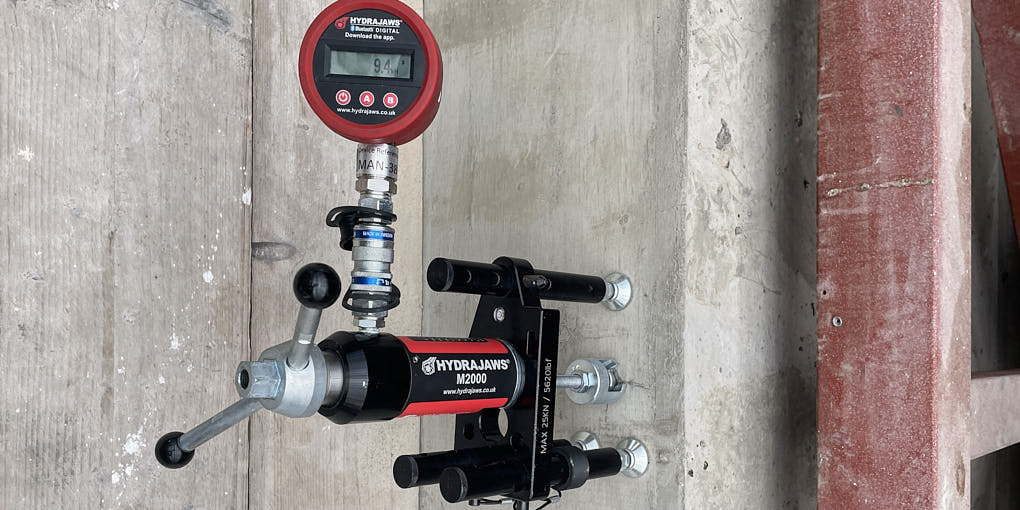
Pull-out testing is used to verify the strength, suitability, and installation quality of structural fixings, such as anchors and embedded components within a structure. The test involves applying a controlled tensile load to the fixing to assess its resistance to pull-out failure or excessive movement.
This type of testing is commonly required where fixings are safety-critical, where the substrate condition is uncertain, or where proof testing is needed to confirm that installed anchors meet the required design or manufacturer’s performance criteria.
Anchor Pull-Out and Proof Load Testing
Pull-out testing can be carried out on a wide range of fixing types, including:
- Chemical and resin-bonded anchors
- Expansion anchors
- Grouted-in reinforcement bars
- Threaded rods
- Cast-in or post-installed fixings
- Channel sections with T-bolts
- Structural fixings installed into concrete, masonry, or other substrates
Testing can be undertaken as either proof load testing to verify installation against a specified load, or destructive testing to determine the ultimate capacity and failure mode of the fixing or substrate.
Where required, movement of the anchor or fixing can also be monitored during testing using displacement gauges connected to a data logger.
Sandberg can carry out pull-out testing from 50kg to 50 tonnes. We offer advice and rapid response with the capability to fabricate test equipment to enable load tests in virtually any situation.