
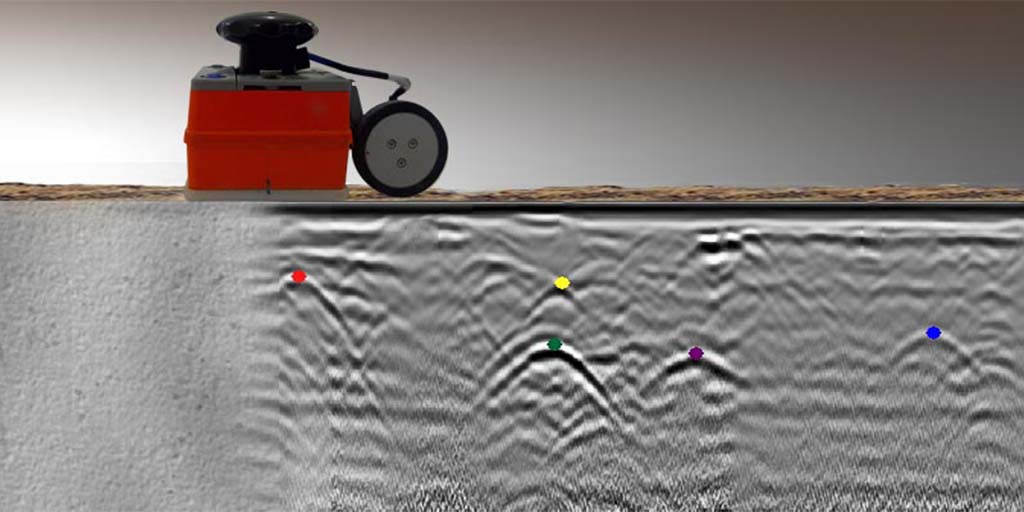
GPR is a flexible, non-intrusive and non-destructive technique for the investigation and characterisation of the sub-surface. For more information about the wide and varied applications of GPR, visit our dedicated website about Ground Penetrating Radar surveys offered by Sandberg.
How Ground Penetrating Radar Works.
Ground Penetrating Radar utilises an antenna (comprising a transmitter and receiver a small fixed distance apart) to send electromagnetic waves into the subsurface. The antenna is moved over the surface of the medium to be inspected. The transmitter sends a diverging beam of energy pulses into the subsurface and the receiver collects the energy reflected from interfaces between materials of differing electrical properties. The reflected energy is recorded as a ‘pattern’ on radargrams which are displayed in real time. The radargrams constitute the raw Ground Penetrating Radar data. They are displayed in real-time on the control unit and basic interpretation can be conducted on-site. Usually, however, the radargrams are processed and analysed off-site using specialist software.
GPR Antennas
Depending on the application, antennas with different central frequencies are utilised to adapt to specific conditions and survey requirements. In general, low-frequency systems exhibit greater penetration but yield lower data resolution; conversely, high-frequency systems have limited penetration but provide significantly higher resolution. By employing multiple frequencies to scan the same area, the information collected in the ground penetrating radar (GPR) data can be effectively maximized.
| Antennae Frequency | Maximum Penetration Depth | Examples of Potential Use |
| 1500 MHz | 0.5 m | Rebar mapping and concrete evaluation. |
| 900 MHz | 1 m | Pipe and void detection or assessing concrete thickness. |
| 400 MHz | 4 m | Utility surveys, pavement evaluation, storage tank detection and assessing structural integrity. |
| 270 MHz | 6m | Utility surveys, geology and archaeology. |
The above table shows the maximum penetration that the different antenna frequencies can achieve. In practice, the limiting factor is generally dictated by ground conditions. GPR works best in sandy soil. It does not work well in heavy clay soils, where depth penetration is severely compromised.
GPR Data Analysis
Sandberg uses GSSI Radan software for off-site processing and analysis. Data processing can filter out unwanted noise and interference, apply corrections and enhancements, calculate depth and more. If the data has been collected on regular orthogonal grids, adjacent scans can be combined to produce 3D models if required.
